Designing a Dropper Tycoon Economy From Scratch
Building a tycoon economy requires balancing just two numbers: income and upgrade cost.
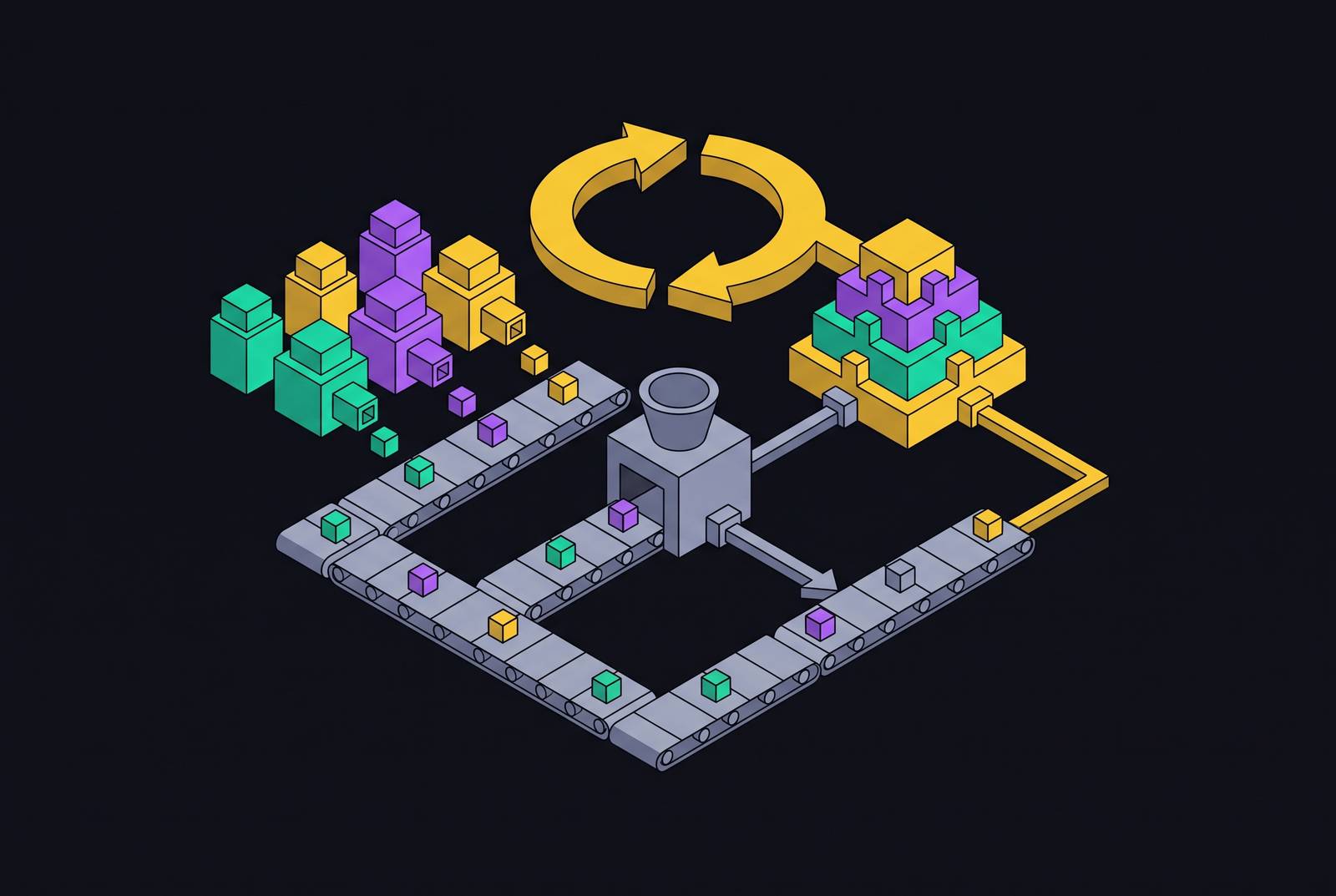
A dropper tycoon runs on two numbers, and that's it. Income per second and upgrade cost. Everything else, the conveyor animations, the collector design, the zone art, is decoration draped over the relationship between those two figures. The mechanical skeleton hasn't changed across the genre: items fall from a dropper, ride a conveyor, hit a collector, and turn into cash. That loop is simple enough to explain to a ten-year-old in one sentence. Designing it well, though, means understanding that income per second is really two sub-variables stacked together (the value of each dropped item, and how often items drop) and that upgrade cost is the price tag that decides how long a player stares at that number before they can afford the next button. That wait time is the actual product being sold here. Most first-time creators set these numbers by feel, or by copying whatever tycoon they played last week, and the result appears fast: either upgrades feel impossibly far away and players bounce, or upgrades arrive so quickly there's no tension left to enjoy. Get the two-number relationship right, and the rest of the game design mostly takes care of itself.
Setting your first dropper's base value and drop rate
Before a single upgrade button or zone gets built, the starter dropper needs its numbers locked down, because every price tag in the game will end up being some multiple of this one figure. Get the starter dropper wrong and the error compounds through every system built on top of it.
Two decisions come first, in order, not at the same time. Pick the drop rate first: how often an item falls determines how active the opening minutes of the game feel. A fast drop rate rewards a player who's watching the screen and clicking around. A slower one rewards a player who checks back in a few minutes later. Then set the drop value, the currency each item represents, based on how fast you want that first upgrade to feel reachable. It's a wait time translated into currency.
Decide the first upgrade should take a new player roughly two minutes of saving at starter income. Multiplying that income-per-second figure by the number of seconds in that two-minute window gives the target price for the first upgrade. From there, set drop value and drop rate to produce the income-per-second that hits that target. The common mistake runs the opposite direction: picking a drop value first with no idea what the first upgrade should cost, then backing into an upgrade price that feels arbitrary and off-rhythm once the game is live.
Building the upgrade cost curve so each purchase feels earned but not punishing
The upgrade cost curve is probably the single most important document a tycoon designer ever produces, because it decides whether a player feels forward motion or feels stuck at every stage of the game.
The pattern that holds up: each upgrade costs enough that it takes roughly the same wait time to afford at current income, and buying it raises income enough that the next upgrade becomes reachable in a similar window. That means cost grows geometrically, and income needs to grow geometrically right alongside it. Flat, linear cost growth breaks this fast. If prices rise by a fixed amount while income grows multiplicatively, the early upgrades turn trivially cheap and the later ones slam into a wall. Where costs outpace income, players hit the stall that makes them close the game and never come back.
Ratio thinking is the tool that keeps this stable. Each upgrade's price should be a consistent multiple of the income-per-second a player had just before buying it, which keeps wait times steady through the early game. Each upgrade's income boost should likewise be a consistent multiple of the income it's replacing, which keeps the feeling of progress consistent run after run. Holding both ratios steady keeps the wait times feeling fair no matter what the raw numbers actually are.
There's room to break this pattern on purpose. A "spike" upgrade, one priced well above what the curve predicts but paying off with a disproportionate income jump, gives players something to save toward and remember. Save it for a zone transition or a major unlock so it reads as a milestone.
Introducing additional droppers without inflating income out of control
Adding a second dropper is not the same move as doubling income with an upgrade. It resets the baseline the entire cost curve was calibrated against, so it has to be treated as a deliberate re-anchoring of the economy, a distinct decision from just another item on the shop list.
Each new dropper should be priced and timed so it restores roughly the same wait rhythm the first dropper delivered. If the first dropper took two minutes of saving to reach the first upgrade, a second dropper, or an upgrade with an equivalent income bump, should bring back something close to that same two-minute rhythm. It shouldn't permanently cut every future wait time in half. Let players stack droppers without limit and income can outrun the cost curve entirely, flooding the mid-game with currency and making every later upgrade trivially affordable, which kills the anticipation the whole design was built to protect. Designers manage this a few different ways: capping dropper slots or plot space so each dropper is a real decision rather than a bulk buy, building in diminishing returns so each additional dropper adds less than the one before it, or scaling dropper cost with the number already owned so mass-buying becomes self-limiting. None of these approaches is inherently better than the others. The right choice depends on how fast the designer wants the mid-game to move.
Pricing automation unlocks against income-per-second
Automation, conveyors that run themselves, auto-collectors, AI-driven workers, changes the economy in a way that's different in kind from an income-boosting upgrade. It removes the need for the player to do anything at all to keep income flowing. That's a shift from active management to system optimization, and it has to be priced like the shift it is, not like one more upgrade on the list.
Introduce automation too early or too cheap and the player never spends enough time in the manual loop to appreciate what automation is relieving them of. The contrast that makes automation feel good, the memory of grinding manually, never gets to form. Introduce it too late, or price it too high, and the manual loop just becomes repetition with no payoff in sight, which is the exact moment a dropper tycoon earns the "just an idle game with 3D graphics" label.
Pricing automation correctly means anchoring the price to projected income-per-second after the purchase, not the income the player has right now. The player is buying a permanent change to how the entire economy runs, so the price needs to reflect that long-term value. Once automation is live, the interesting decisions shift too. Instead of asking which upgrade to buy next, players start asking how to arrange the system for maximum output: conveyor paths, collector placement, upgrader positioning. That turns into an optimization puzzle that keeps players engaged without the designer needing to add new content to hold their attention.
How zone progression resets the economy's frame of reference
Zone transitions are the most powerful tool a tycoon designer has for stretching the game's lifespan. Each new zone can bring its own income scale, its own upgrade types, and its own cost curve, without the player feeling like they're starting the game over, because they carry their progress and their identity into it.
The trick works like this: a player enters a new zone with income that felt enormous in the zone they just left, and finds it looks modest against the new zone's upgrade prices. That compression is intentional. It recreates the satisfying early-game rhythm without forcing returning players to grind through content they've already mastered. Calibrating this well means the first upgrade in a new zone has to be affordable within a short window at whatever income level the player is carrying in, so the zone reads as reachable and rewarding right away, not as a punishment for progressing.
Dropper Tycoon X leans on exactly this structure, using zones "packed with advanced upgrades" and "bigger rewards" as its escalation mechanism. Each zone functions as a fresh economy layer stacked on top of the last, rather than one continuous curve stretched to the breaking point, and that layering is what lets the game sustain its "from nothing to god status" arc without the mid-game collapsing under its own numbers. What a zone should never do is strip away a player's automation, reset their plot layout, or lock them out of zones they've already earned. That reads as punishment, and punishment is the fastest way to lose a player who was otherwise having a good time. A new zone should raise the ceiling. It shouldn't touch the floor.
Where prestige fits into the economy
Prestige takes the wealth a player built by the end of a run and converts it into a permanent multiplier, then resets the economy back to its early state. Its design value lies entirely in making that early game faster and more satisfying each time through, provided the multiplier earned is worth the reset.
The reset itself needs careful boundaries. Resetting income and upgrade purchases is expected and fine. Resetting automation unlocks, plot layout, or zone access almost always reads as punishment, and it's the fastest way to make players avoid the prestige loop. Calibrating the multiplier is its own balancing act: it needs to be large enough that the second run through the early economy feels noticeably faster than the first. Too small, and players see no reason to bother prestiging. Too large, and the early game becomes instant, which kills the exact pleasure the loop was built to deliver.
Prestige also creates a second economy running alongside the main one, and that secondary currency or multiplier needs its own cost curve governing it. Letting prestige bonuses stack cheaply means players will quickly reach a point where the original economy, the dropper, the upgrades, the zones, stops mattering.
Where cash logic must live in the code
Every cash calculation and every purchase has to run in server-side scripts, never on the client. It's the structural condition that decides whether the economy a designer built is the economy a player actually experiences.
Currency or purchase logic that runs client-side can be manipulated locally by any player with basic tools, and the upgrade cost curve, the prestige multiplier, every economic decision calibrated over hours of design work, gets bypassed in seconds. It's the single most common technical failure in the genre. A multiplayer tycoon compounds the stakes further, because each player needs their own plot, their own droppers, collector, and buy buttons, running independently. That means the server has to track every player's cash state separately, and any shortcut that stores cash client-side opens an exploit that doesn't just hurt one player, it undermines the economy for everyone sharing the server.
The clean version of this architecture uses identical plot models stored server-side and assigned to players as they join, with every piece of state, cash balance, upgrade tier, automation status, held in server scripts and updated through RemoteEvents the server validates before acting on anything. Building that architecture from scratch takes real scripting knowledge, and that's historically where a lot of well-designed economies stalled out before they ever reached a player.
AI-assisted creation tools for solo and first-time creators
The scripting wall used to be where economy design turned academic. A creator could work out the perfect ratio between income and upgrade cost on paper and still never ship it, because the gap between that design and a working multiplayer game required writing server architecture by hand. That gap has narrowed considerably.
AI-assisted game creation platforms can now handle the scripting layer directly from a plain-text description: dropper logic, cash tracking, upgrade buttons, server-side purchase validation, the whole stack. A creator who's thought carefully through income-per-second ratios and cost curves can turn those decisions into a working build without touching Lua. Paralov's browser-based game generator is a concrete example of this, producing a functional dropper tycoon from a written description and turning theory into testable numbers in minutes. That matters specifically for tycoon economy design, because the systems that stop first-time builders cold, server-side cash logic, per-player plot assignment, upgrade state that actually persists, are the exact systems AI tooling handles most reliably, since they follow consistent, repeatable patterns across games.
None of this replaces the design thinking covered everywhere else in this piece. Once a creator has settled on a target wait time for the first upgrade and worked backward to the drop value and rate that hit it, the longest stretch of the old process was scripting the dropper, wiring the conveyor, building the collector by hand. Platforms that automate that mechanical skeleton, Paralov among them, let a designer spend that time iterating on the actual economy numbers through play instead of rebuilding the same technical foundation over and over. Tools handle implementation. They don't supply intent. A creator who hasn't worked out their cost curve or their automation timing will ship a poorly balanced tycoon exactly as fast as one who has, just with fewer excuses standing in the way.
The decisions that separate a tycoon with staying power from one that empties out after day one
Retention in a dropper tycoon is what happens when an economy holds the right ratio between income and upgrade cost at every single stage, including the late game and the prestige loop, not just the opening ten minutes.
The tycoons that keep players around past the first week share one trait: there's always a next thing that feels within reach but not immediate, and the ratio check a designer ran during development turns out to be the same calculation a player runs intuitively every session they come back for. Getting discovered and getting kept are different problems, and discovery alone won't cover for a shaky economy. A tycoon that draws players in but empties out fast loses ground in discovery rankings too, since the systems that surface games to new players reward sustained concurrent players and deep sessions, not a launch-day spike that fades by the weekend. That makes economy design, not any single feature or art pass, the actual competitive advantage here, the one thing no template or copy-paste job can hand a creator for free.
A few checks cover most of what matters before publishing. The wait for the first upgrade should roughly match the wait for upgrades deep in the mid-game. Does each automation unlock land as a relief that was earned, rather than a default setting the player forgot existed? Does the prestige multiplier make the second run feel meaningfully faster without making the early loop feel pointless to even play? Is the first upgrade in every new zone reachable within a short window at the income a player carries in from wherever they just left? And is every piece of cash logic sitting on the server, with nothing a player could tamper with from their own machine? Answer those honestly, and the two numbers this whole piece started with, income per second and upgrade cost, stay in the right relationship from the first drop to the hundredth prestige.